
A steering problem almost never starts big. It begins as a faint noise, a bit of extra effort at the wheel or a slight wander you only notice on the highway. Left alone, though, it tends to grow. We see the same small set of issues walk through our doors in Pickering and Etobicoke week after week and most of them are easy enough to pin down once a car is up on the lift.
Below is a closer look at what tends to go wrong with a steering system including a few causes that often get overlooked entirely.
Low or Leaking Power Steering Fluid
A whining sound when you turn the wheel is one of the first things we listen for. Hydraulic power steering relies on fluid pressure to make turning effortless, so once the fluid drops that ease disappears with it. You will hear it mostly at low speed when parking or making a tight turn.
The fluid rarely just runs out on its own. A worn hose, a loose fitting or a failing seal at the pump or rack is behind it. Topping up the reservoir might quiet things down for a week, but we always chase the leak back to its source rather than treat the symptom.
Worn Tie Rod Ends
Tie rods link your steering rack to the wheels themselves and years of driving eventually wear them down. A clunk over bumps, a car that drifts slightly at highway speed or a steering wheel with a little too much give in it are all signs worth paying attention to.
We do not recommend waiting on this one. A tie rod that fails completely can mean losing control of the wheel, so replacement gets prioritized. It is also common practice to check alignment right afterward, since a worn tie rod tends to throw the wheel angles out of spec.
A Power Steering Pump on Its Way Out
Sometimes that whine turns into something closer to a grind or a growl. It does not go away no matter how much fluid you add. That points to internal wear inside the pump itself. Steering can also start to feel inconsistent and stiff at idle plus easier once the engine warms up then heavy again.
Pumps rarely quit without some kind of warning first. Catching the noise early, before the pump seizes entirely is a far simpler fix than dealing with a sudden loss of power assist on the road.
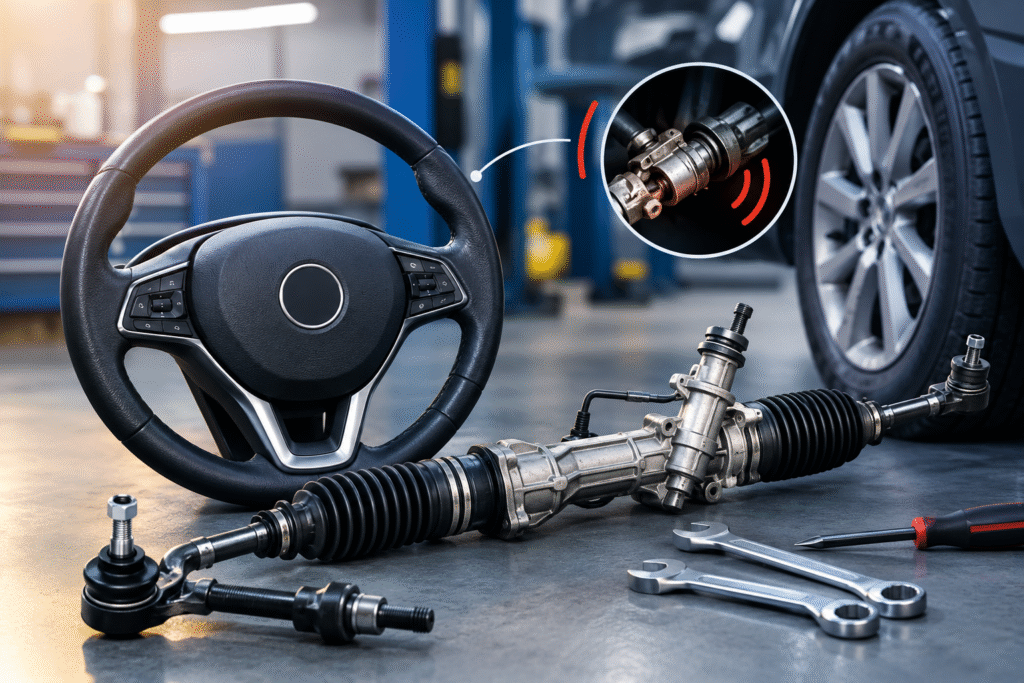
Rack and Pinion Wear
The rack is what turns the motion of your steering wheel into the actual movement of your front tires, so when it starts to wear, you feel it almost everywhere. A vague or loose feeling at the wheel, a knock when turning or fluid pooling underneath the front of the car are the usual tells.
Depending on how far along the wear is, the fix might be as small as a new seal or as involved as a full rack replacement. This is one of the more expensive steering repairs out there, which is exactly why smaller symptoms are worth acting on early.
What Often Gets Misdiagnosed
Two causes get mistaken for steering trouble more often than they should. The first is a worn upper strut mount bearing. It produces a squeak or creak specifically when you turn the wheel at very low speed, almost always while parking or pulling out of a driveway and it is frequently blamed on the power steering pump instead. The second is a worn CV joint, which tends to click during sharp turns but has nothing to do with steering at all.
Telling these apart matters, since fixing the wrong part solves nothing and costs money you did not need to spend. A proper inspection isolates the actual source rather than guessing based on where the noise seems to come from.
Loose Steering or Excess Play
If the wheel needs more turning than it used to before the car actually responds, something in the linkage has developed play. Worn tie rods, a loose rack or wear inside the steering column can all be responsible and this tends to show up more on older or higher mileage vehicles.
Since several worn parts can produce a nearly identical feeling behind the wheel, a full inspection is really the only reliable way to know which one is actually at fault.
Electric Power Steering Faults
Plenty of newer vehicles skip the hydraulic pump altogether in favor of an electric motor and while these systems need far less routine upkeep, they are not foolproof. A dashboard warning light or a sudden jump in steering effort can point to a fault in the motor or its wiring. Transport Canada has issued recalls for exactly this kind of fault on certain models in the past. It is worth checking for an open recall if your steering suddenly feels heavier than usual.
Why It Pays to Deal With This Early
Steering problems do not tend to fix themselves. A small leak grows. A slightly worn tie rod becomes a loose one. A faint pump noise can end in a full loss of power assist at the worst possible time. Since steering is what lets you react in the first place, we treat these repairs as something to handle now, not later.
Get Your Steering Checked at Supreme Lube
If something about your steering feels off, whether that is a new noise, extra play in the wheel or more effort than it used to take, it is worth having someone actually look at it. We offer walk in steering system maintenance and repair with no appointment needed, at both our Pickering and Etobicoke locations. Learn more about our shop or reach out to our team to get it looked at properly.
FAQs
Why does my steering wheel make noise when I turn it?
A whine points to low power steering fluid. A grind or growl means the pump is wearing out inside.
Is it safe to keep driving with a power steering problem?
It depends how serious it is. A small leak is not urgent, but a sudden loss of power assist or a grinding pump needs attention right away.
Why does my steering wheel feel loose or have too much play in it?
This is worn tie rod ends or a worn rack plus looseness in the steering column and it tends to get worse the longer it sits.
Why did my steering suddenly get hard to turn?
Low fluid, a failing pump or on newer cars including a fault in the electric power steering system are the most common culprits.
How much does steering repair typically cost?
It depends entirely on what is actually wrong. A fluid leak is a fraction of the cost of a full rack replacement, so an inspection is really the only way to get a number worth trusting.