
Have you ever wondered why your vehicle doesn’t drag, skip, or skid when turning corners? The answer lies beneath your vehicle in a critical drivetrain component: the differential.
Like your engine, your differential relies on specialized fluid to operate. While most Durham Region drivers know their regular oil change schedule, differential fluid is frequently neglected. Overlooking this vital fluid can lead to catastrophic drivetrain failure and expensive repair bills.
This guide breaks down exactly what differential fluid does, when you need to change it, and how Supreme Lube in Pickering keeps your drivetrain running smoothly.
What Differential Fluid Actually Does
When your vehicle turns a corner, the outside wheel has to travel a longer distance than the inside wheel. The differential is the mechanical component that allows your wheels to rotate at different speeds during a turn.
Inside the differential housing, heavy-duty gears continuously mesh together under extreme pressure and heat. These gears are coated in differential fluid (also called gear oil). This fluid serves three critical purposes:
- Reduces intense friction between meshing gear teeth
- Transfers heat away from metal surfaces
- Prevents metal-on-metal grinding and premature wear
Gear Oil vs. Engine Oil
Differential fluid is not the same as engine oil or transmission fluid. It is much thicker and contains specific extreme-pressure additives. It is formulated to handle the heavy, grinding loads between gear teeth rather than the high-speed, fast-moving parts inside an engine block.
Signs Your Differential Fluid Needs Attention
Because the differential sits underneath your vehicle, you cannot easily check its fluid level with a dipstick. Instead, look and listen for these common warning signs:
- Whining or Humming: A distinct howling noise that gets louder as you accelerate.
- Clunking or Banging: Skipping or clunking sounds specifically when turning corners.
- Vibrations: Physical vibrations felt through the floorboards at highway speeds.
- Burning Smell: A harsh, acrid odor after driving, indicating overheated gear oil.
- Fluid Leaks: Dark, thick fluid spots pooling under your front or rear axle area.
If you experience any of these symptoms while driving around Pickering, pull into Supreme Lube immediately before a minor fluid issue turns into a total gear replacement.
The Correct Interval for a Differential Fluid Change
There is no universal mileage for a differential service, but standard Canadian driving conditions dictate these general ranges:
- Standard Passenger Vehicles: Every 50,000 to 100,000 kilometres.
- Trucks, SUVs, and Towing Vehicles: Every 25,000 to 50,000 kilometres.
- Severe Conditions (Extreme Cold/Stop-and-Go Traffic): Closer to the shorter interval end.
Factors That Shorten Fluid Life
The GTA is notorious for harsh winters, humid summers, and heavy stop-and-go traffic on the 401. These conditions accelerate fluid breakdown. Furthermore, All-Wheel Drive (AWD) and Four-Wheel Drive (4WD) vehicles feature multiple components—including a front differential, a rear differential, and a transfer case—meaning they require more frequent drivetrain fluid maintenance than standard front-wheel-drive cars.
What a Differential Fluid Change Involves
At Supreme Lube, a professional differential service is quick and precise:
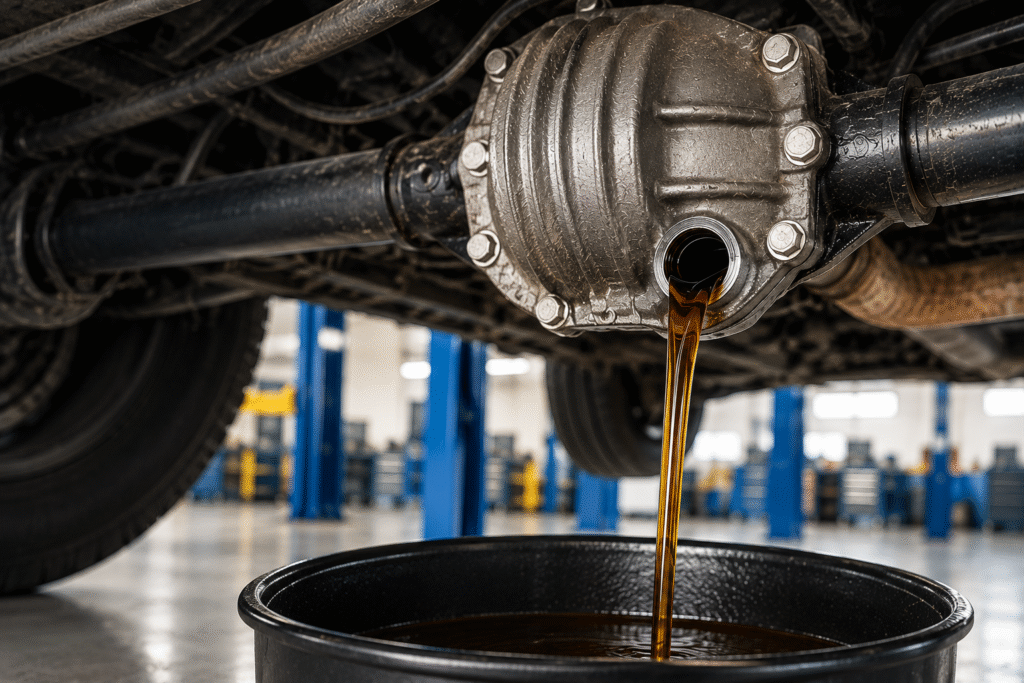
- Draining: We remove the drain plug to completely evacuate the old, broken-down fluid.
- Inspection: We inspect the magnetic drain plug for excessive metal shavings, which indicate severe internal gear wear.
- Sealing: We inspect the housing gasket and seals for leaks.
- Refilling: We pump in fresh, high-quality gear oil matching your manufacturer’s exact viscosity specifications (e.g., 75W-90 or 80W-90).
Why Trust Supreme Lube for Differential Fluid Service?
Drivetrain maintenance does not have to be a hassle. At Supreme Lube, we treat your vehicle’s fluids holistically.
- No Appointments Needed: Drive right into our Pickering bays at your convenience.
- No Upselling: We check your fluid levels, quality, and seals first. If your gear oil is healthy, we will tell you.
- Comprehensive Maintenance: Tie your differential service into your routine warranty-approved warranty oil change, transmission fluid flush, or radiator service.
Conclusion
Differential fluid works silently out of sight, but ignoring it can turn a routine maintenance item into a multi-thousand-dollar axle replacement. Staying ahead of your manufacturer’s maintenance schedule keeps your vehicle dependable and safe.
If you are unsure when your gear oil was last serviced, let our team look underneath the vehicle for you. Visit Supreme Lube in Pickering today for fast, honest, and professional fluid maintenance.
Frequently Asked Questions (FAQs)
Is differential fluid the same as gear oil?
Yes, the terms are used interchangeably. It refers to the high-viscosity lubricants specifically designed for automotive gearboxes and differentials.
Can I just top up the differential fluid if it is low?
Topping up solves a low-fluid symptom but leaves behind internal contaminants, moisture, and metallic debris. A full drain and refill is required to protect the gears.
Does a AWD vehicle have more than one differential?
Yes. AWD and 4WD vehicles typically have a front differential, a rear differential, and a central transfer case or power transfer unit (PTU). All of these require regular fluid changes.
Is the differential located under the hood?
No, the differential is located underneath the chassis between your wheels. On rear-wheel-drive vehicles, it is the large metal bulb in the center of the rear axle.